Coffee · Korean daily life
Korean Budget Coffee Chains Explained: Mega, Compose, Paik’s and More
By late morning, Seoul can already feel like a full day when you are travelling with a toddler. Korean budget coffee chains often matter for the same reason they matter to commuters and office workers: they can be quick, familiar stops that help tired adults reset and keep moving.
Korean budget coffee chains work like small pieces of urban infrastructure: quick, familiar stops between commutes, lunch breaks, errands and the next part of the day.
Last checked: July 17, 2026
Quick answer
Mega MGC Coffee
Choose Mega when you want the clearest large-iced-drink experience and an obvious first look at Korea’s bright, value-coffee format.
Compose Coffee
Choose Compose when there is a branch directly on your route and you want a straightforward everyday stop rather than a destination cafe.
Paik’s Coffee
Choose Paik’s when you want the menu itself to feel local, with distinctive drinks and official item-level caffeine and allergen guidance.
Mammoth Coffee
Choose Mammoth when one adult needs to step in, order quickly and return to the family without turning coffee into a long stop.
The Venti
Choose The Venti when your group has mixed preferences and you want one menu with coffee, decaf and many non-coffee-style options.
These are BabyMap editorial labels based on official positioning and menu evidence. They are not taste rankings or a cheapest-price table.
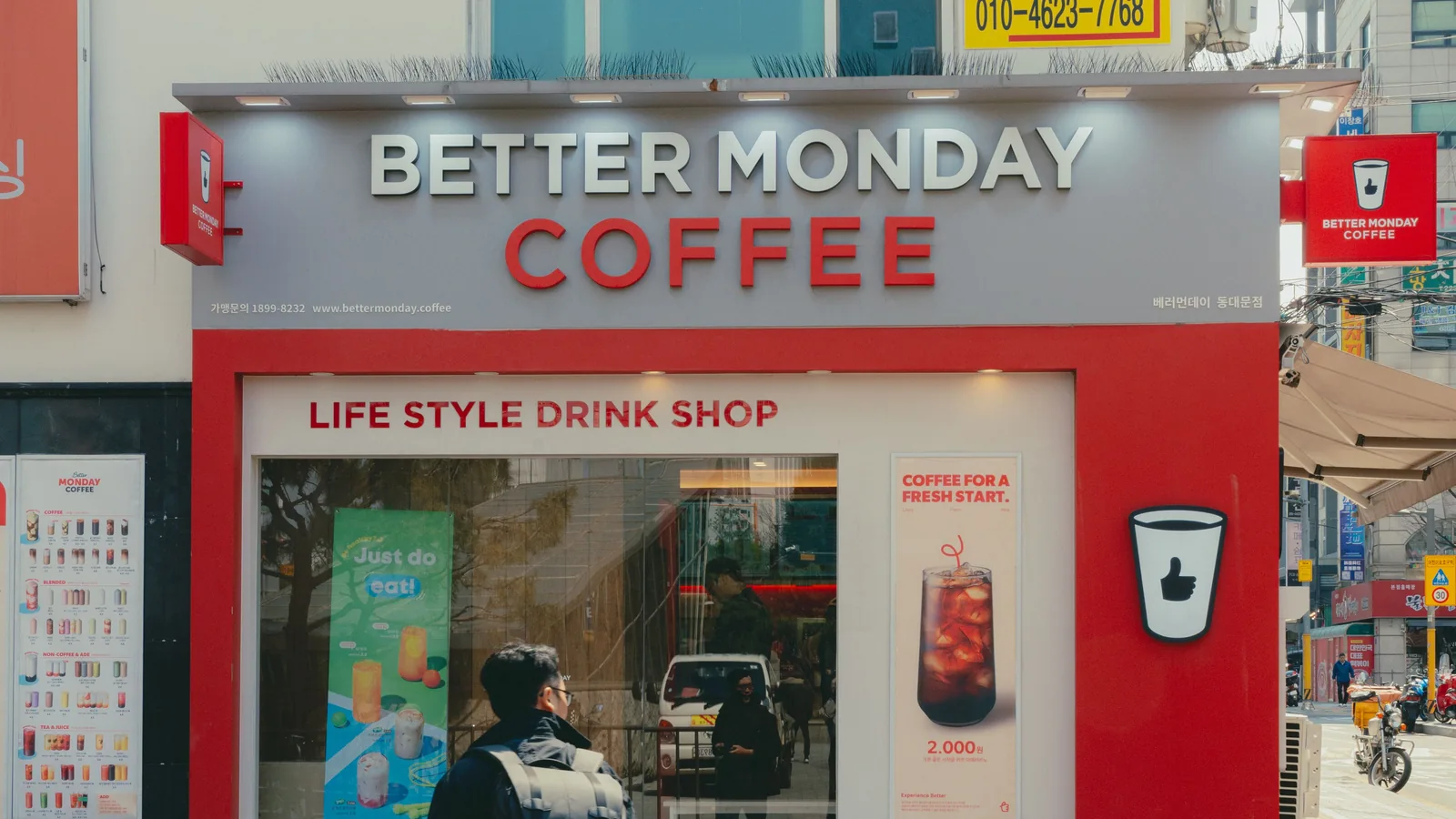
Some details may change. We mark unverified info clearly — please check the official website before visiting.
Why these chains exist
Some Korean cafes are destinations for sitting, studying or meeting friends. Budget chains usually solve a different problem: order, pick up and keep moving.
That utility matters to commuters, students, office workers and travelling parents who need a practical five-minute stop instead of a long seated break.
This guide explains five brands by use and official positioning, not as a definitive taste ranking, cheapest-price table or current store-count race.
Five chains explained
Mega MGC Coffee
Mega is the loud, cheerful member of the group. Its bright branding and oversized iced cups make it the easiest version of the category for many visitors to notice first.
The official brand page says the chain is built around large drinks, rational pricing, Arabica coffee and visually distinctive seasonal menus, and it describes a standard large format of 24 ounces, or 680 millilitres. Use that as brand positioning, not as a promise that every product follows the same exact format.
Mega works best when you want one obvious budget-chain experience and do not need the stop itself to become the destination.
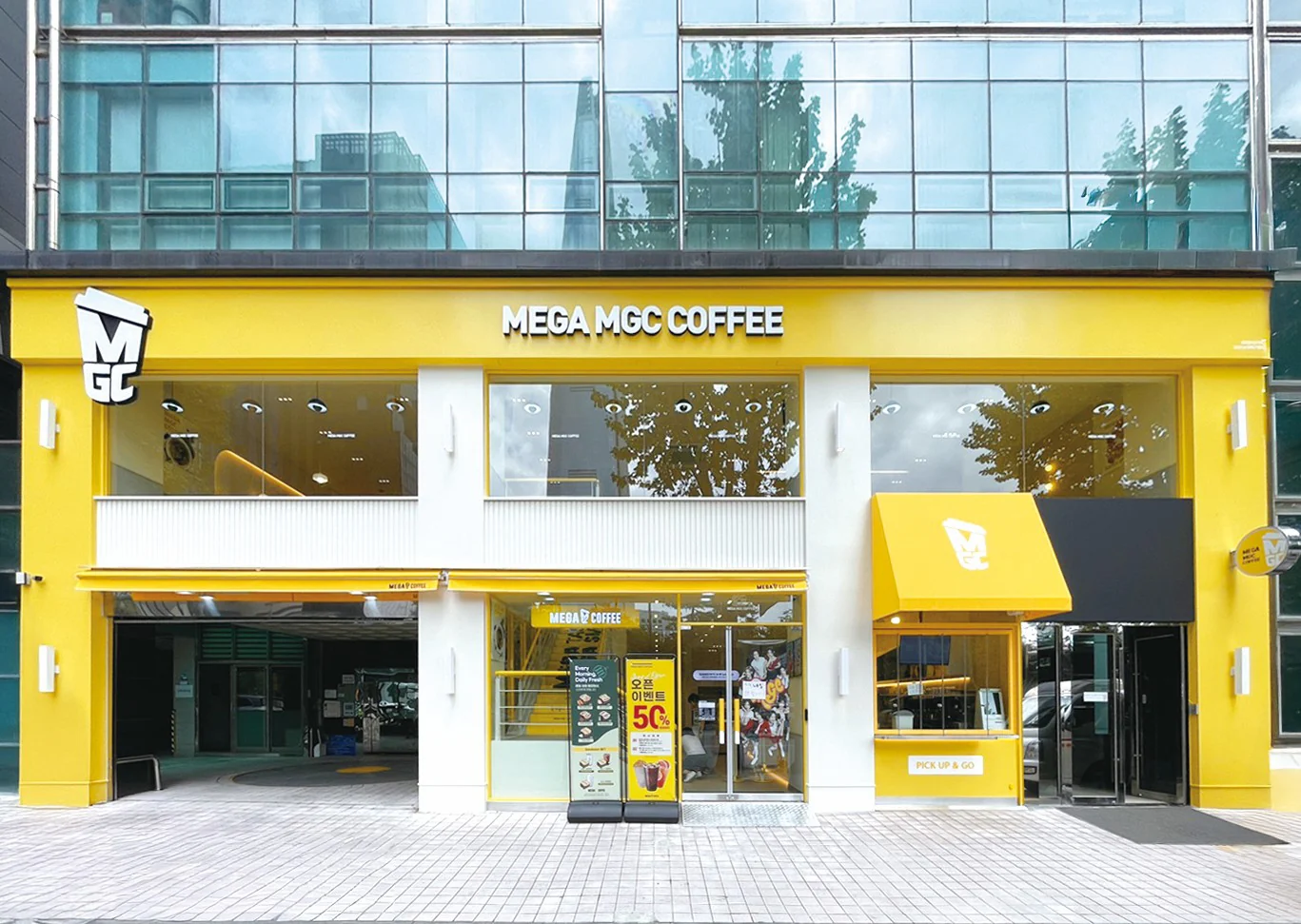
What the store looks like
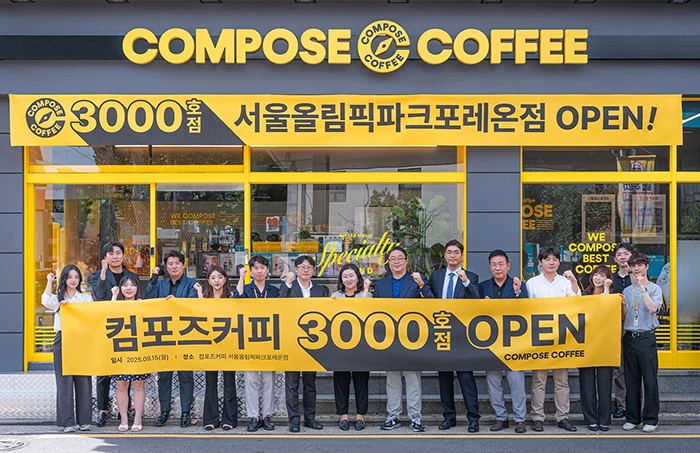
Compose Coffee

Compose feels less like a tourist destination and more like a neighbourhood utility. It is one of the names travellers repeatedly see while trying to understand Korean everyday coffee chains.
The current official channels list broad categories including coffee, beverages, blended drinks, tea, food and desserts, and current materials also promote decaf. That makes Compose useful when you want a simple takeaway choice without visiting a larger premium cafe.
The practical appeal is convenience, not theatre: if a Compose branch is already on your route, it can be a dependable adult reset before the next subway ride, museum stop or hotel return.
What the store looks like
Paik’s Coffee
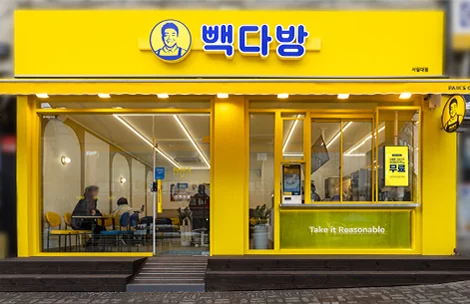
Paik’s Coffee can be the most interesting first visit when the traveller wants the menu itself to feel more distinctly Korean than a familiar latte order.
The official brand page emphasises rational pricing, quality ingredients and signature visual drinks. Its current menu stretches well beyond standard coffee into sweet mixed-coffee styles, iced tea with espresso, flavoured Americanos, smoothies and desserts.
For families, the most useful difference is that official Paik’s menu pages publish caffeine, sugar and allergen information for many individual items. That makes it easier to ask better questions before ordering.
What the store looks like
Mammoth Coffee
Mammoth makes the most sense when you see it around office buildings at lunchtime. This is the brand that most clearly explains the office-worker rhythm behind the category.
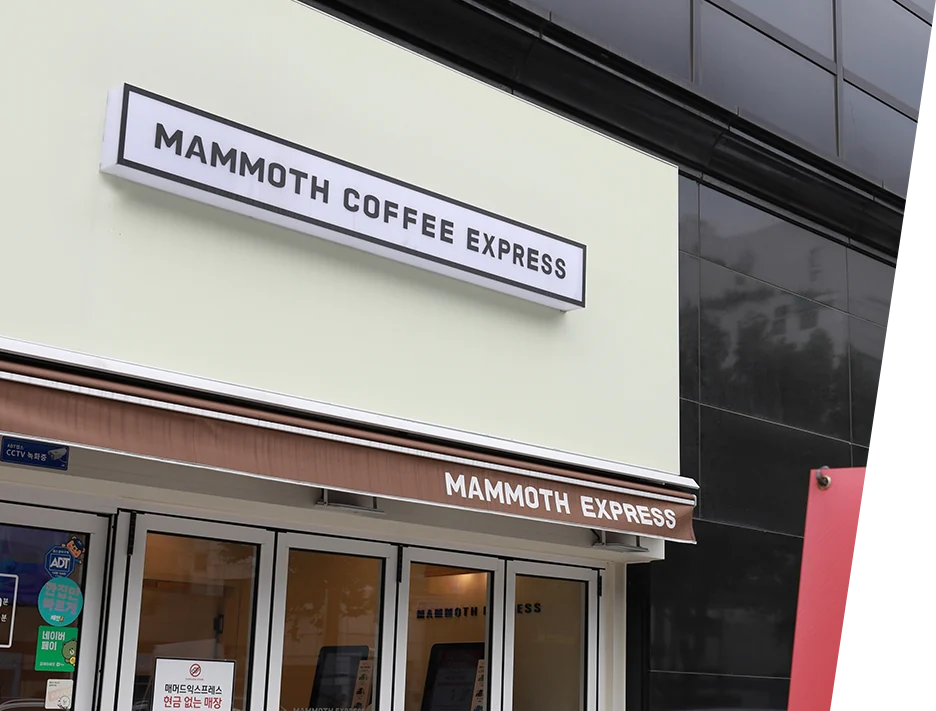
You may see either Mammoth Coffee or Mammoth Express on the sign. Mammoth Express is the compact, quick-order format and is common around offices and subway exits.
Mammoth’s official brand story says Mammoth Express introduced kiosks and automated coffee equipment to build a fast, convenient service system. That is useful evidence for the chain’s speed-first identity, not a promise that every branch has the same exact layout or interface.
Mammoth is often the best option when one adult can step in, order quickly and return to the stroller or family waiting outside.
What the store looks like
The photo below shows a Mammoth Express branch — the compact quick-order format often seen near offices and subway exits.
The Venti

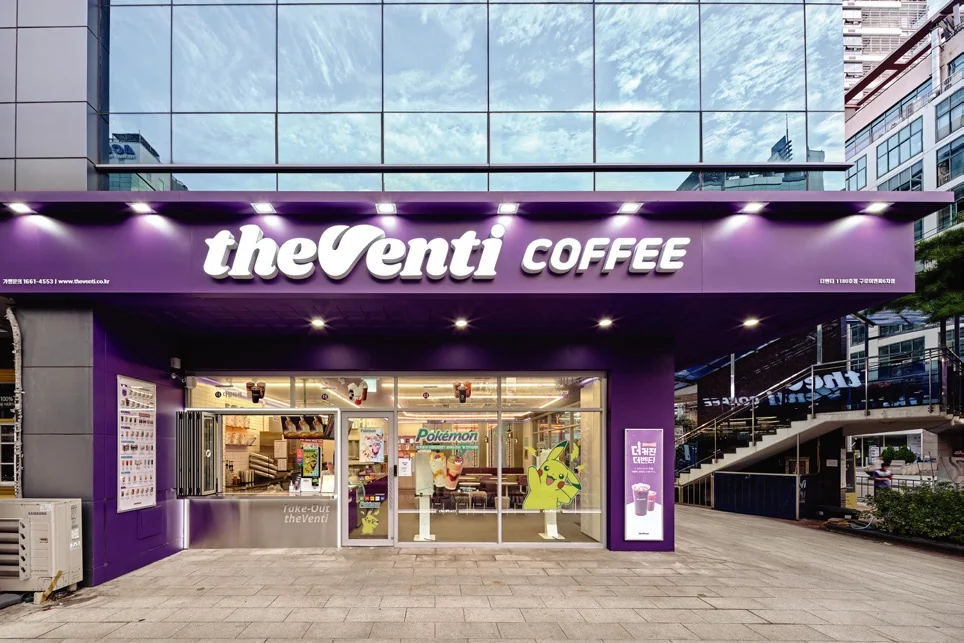
The Venti’s most useful feature for mixed groups is menu breadth. It can work well when two adults want different caffeine levels or when not everyone is looking for coffee only.
The current official menu separates coffee, decaf, blended drinks, juices and ades, bubble tea, tea and other beverages. That broad category structure is a practical strength, especially for a first-time visitor scanning the board for options.
Use The Venti when convenience and range matter more than choosing one narrow coffee identity.
What the store looks like
Context
Not in the five, but useful for comparison
Ediya Coffee
Ediya often feels like a bridge between micro takeaway chains and larger sit-down franchises. Some branches are compact, while others are used for conversations or study.
Treat the individual store, not the logo, as the source of truth for seating and restrooms.
Starbucks Korea
Starbucks usually costs more than the lowest-priced chains and many branches are designed for a longer stay, but city-centre stores can still be crowded.
A Starbucks logo does not guarantee stroller space, an available seat or a calmer family stop.
Paul Bassett
Paul Bassett is more useful as a comparison point for parents who care about the coffee itself and are willing to pay more for a different kind of cafe stop.
It points toward the slower specialty-coffee side of Korea’s coffee culture rather than the quick takeaway utility covered in this guide.
What to order first
There is no objective best chain, and this guide does not pretend to taste-test every branch.
Use the first order to learn how the system works rather than to prove which brand wins.
For the simplest comparison: iced Americano
An iced Americano makes the cup size, roast style and value positioning easy to notice.
In casual Korean, people often shorten it to 아아, but saying the full drink name is clearer for a visitor.
For a less bitter first drink: cafe latte
A latte can be easier when you do not usually drink black coffee.
Milk substitutions and decaf changes are not universal, so ask before paying.
For the Korean chain experience: one signature drink
Choose one item the brand presents as distinctive, but check whether it contains espresso, tea, chocolate, dairy, nuts or other allergens, or a large amount of sugar.
A drink that looks playful may still contain caffeine.
For evening or caffeine-sensitive travellers: ask about decaf
Decaf exists across several chains, but the menu and participating stores vary.
Decaf available somewhere in the brand does not mean the current branch can make the current drink decaf.
Branch-reality checklist
Before you queue, scan the branch for these practical details:
- Is there a step at the entrance?
- Can the stroller fit without blocking the queue?
- Is ordering at a counter, kiosk or app?
- Is there anywhere to wait for the drinks?
- Are there actual seats or only a narrow ledge?
- Is the restroom inside the store, shared with the building or absent?
- Will one adult need to stay outside with the stroller?
Brand identity vs branch reality
Brand identity
Menu style, cup size positioning, decaf options and official brand story.
Branch reality
Seating, restrooms, stroller space, kiosk language, payment and whether the exact drink is available today.
Parents and strollers
When the toddler is asleep in the stroller
One adult can wait outside while the other orders. This avoids waking the child to fit the stroller into a small shop.
When both parents are tired
A takeaway stop may be easier than searching for a cafe with available seating.
Carry the drinks to a department-store lounge, park, hotel or the next planned destination where the family can actually rest.
When the child asks for a drink too
Do not treat non-coffee as a children’s category.
Ask whether the exact drink contains coffee, caffeine or listed allergens, and whether it can be made less sweet.

How ordering usually works
Counter
Say the drink, size if needed, hot or iced, and whether it is takeaway.
Kiosk
The exact interface varies. Some kiosks have an English option and some may not.
Payment methods and foreign-card behaviour can also differ, so do not treat one successful kiosk payment as a nationwide rule.
App or mobile order
Brand apps can be convenient for local repeat customers but may require Korean-language setup, a local phone number or a Korean payment method.
Travellers should not build the plan around an app unless they have already tested it.
Pickup
Watch the screen, listen for the order number or keep the receipt.
Small shops can become crowded around lunch.
Order → Pick up → Keep moving
- 1Order
- 2Pick up
- 3Keep moving
Door step → stroller space → kiosk/counter → pickup → restroom
Check each step at the current branch. A familiar logo does not guarantee that every step will work for your family.
- 1Door step
- 2Stroller space
- 3Kiosk or counter
- 4Pickup
- 5Restroom
Five-minute plan
- One adult checks whether the stroller can enter.
- Photograph or point to the exact menu item.
- Ask about decaf, caffeine or sweetness before payment.
- Say 포장할게요 for takeaway.
- Ask for a cup carrier.
- Move to the place where the family can genuinely rest.
Korean phrases to copy
Tap copy, then show the screen at the counter or kiosk.
아이스 아메리카노 한 잔 주세요.
One iced Americano, please.
디카페인으로 변경할 수 있어요?
Can you make it decaf?
덜 달게 해주세요.
Please make it less sweet.
시럽은 빼주세요.
No syrup, please.
포장할게요.
To go, please.
컵 캐리어 주세요.
Can I have a cup carrier?
이 음료에 커피가 들어가요?
Does this drink contain coffee?
카페인이 들어가요?
Does it contain caffeine?
알레르기 정보가 어디에 있어요?
Where can I find the allergen information?
매장 안에 화장실이 있어요?
Is there a restroom inside?
FAQ
Are Korean budget coffee chains only for takeaway?
No. Some branches have proper seating, while others are tiny pickup shops. Seating, restroom access and stroller space vary more by branch than by brand.
Which Korean budget coffee chain is best?
There is no universal winner. Mega is the clearest large-and-colourful experience; Mammoth best illustrates fast office-district takeaway; Paik’s has a distinctly Korean signature-drink menu and detailed nutrition pages; Compose is a dependable everyday option; and The Venti offers broad categories including decaf.
Do all five chains offer decaf?
Several currently advertise or list decaf, but availability can depend on the store, bean and drink. Ask the current branch rather than relying on the brand name alone.
Can I buy a non-coffee drink for my child?
A non-coffee-looking menu item can still contain caffeine, tea, chocolate, espresso or allergens. Check the specific product information and ask the staff. This guide does not designate any franchise drink as universally child-suitable.
Do budget coffee shops have toilets?
Not always. A restroom may be inside, shared with the building or unavailable to customers. Check the branch before ordering when a restroom is essential.
Will a Korean kiosk accept my foreign card?
It may, but kiosk language, payment terminals and card acceptance vary. Keep a physical card available and be ready to order at the counter when possible.
Related guide
Specialty coffee in Seoul
Budget chains solve a different problem from specialty cafés. When you want the coffee itself to be the destination, see our Seoul specialty coffee guide for parents.
How this guide was checked
BabyMap Korea compared current official brand pages, menu pages, nutrition notices and supporting English-language family-travel questions. Reddit and traveller reports helped identify recurring questions, not official rules.
Last checked: July 17, 2026
Sources
- Pulse by Maeil Business News Korea - Korean budget coffee chain market context
- Mega MGC Coffee - official brand page
- Mega MGC Coffee - official BI page
- Mega MGC Coffee - official menu
- Mega MGC Coffee - official store finder
- Compose Coffee - official brand page
- Compose Coffee - official menu
- Compose Coffee - official store finder
- Compose Coffee - official decaf / nutrition notice
- Compose Coffee - official 3,000th store news
- Paik’s Coffee - official brand page
- Paik’s Coffee - official coffee menu
- Paik’s Coffee - official drink menu
- Paik’s Coffee - official store finder
- Paik’s Coffee - official franchise exterior gallery
- Mammoth Coffee - official brand story
- Mammoth Coffee - official homepage
- The Venti - official homepage
- The Venti - official menu
- The Venti - official nutrition / caffeine notice
- The Venti - official 2026 franchise guide (PDF)
- Pexels - Better Monday Coffee Seoul storefront photo
- Pexels - two takeaway coffees photo
- Pexels - hand-drip cafe teaser photo
Related BabyMap guides
A Better Coffee Break in Seoul: 4 Specialty Cafés for Parents
Four specialty cafés that fit different family days—coffee tasting, palace stop, Seoul Station pause and a rainy-day mall option.
Read guideBest Seoul Malls with Toddlers: Baby Lounges, Stroller Access and Rainy-Day Plans
Compare Seoul malls by what your toddler can actually do, baby-care facilities, stroller logistics and rainy-day backup value.
Read guideSeoul Subway with a Stroller: Elevators, Gates, Transfers and What to Avoid
Find elevator exits, wider gates and simpler transfers before you travel Seoul’s subway with a stroller.
Read guide