BabyMap Korea Editorial Team · Getting around
Seoul Subway with a Stroller: Elevators, Gates, Transfers and What to Avoid
Yes, you can use Seoul’s subway with a stroller. The difficult part is usually not the train—it is finding a step-free route between the street, ticket gates, platforms and your final exit.
Plan the elevator route, not only the train route.
Last checked: July 16, 2026
The 30-second answer
This is not a rule against strollers. It is a reminder that the last part of the journey often matters more than the train time.
The subway is usually a good choice when
- your stroller is reasonably compact;
- the adult pushing the stroller can also manage the bags, or a second adult can help;
- your route has no transfer or only one straightforward transfer;
- you are not racing to a reservation; and
- you can leave extra time for elevators and longer corridors.
Consider a baby carrier, taxi or a simpler route when
- you have a double stroller or several large suitcases;
- your route needs multiple transfers;
- your baby must stay asleep through the journey;
- you are travelling during the busiest commuting periods; or
- the final station leaves you with steep streets, stairs or a long walk.
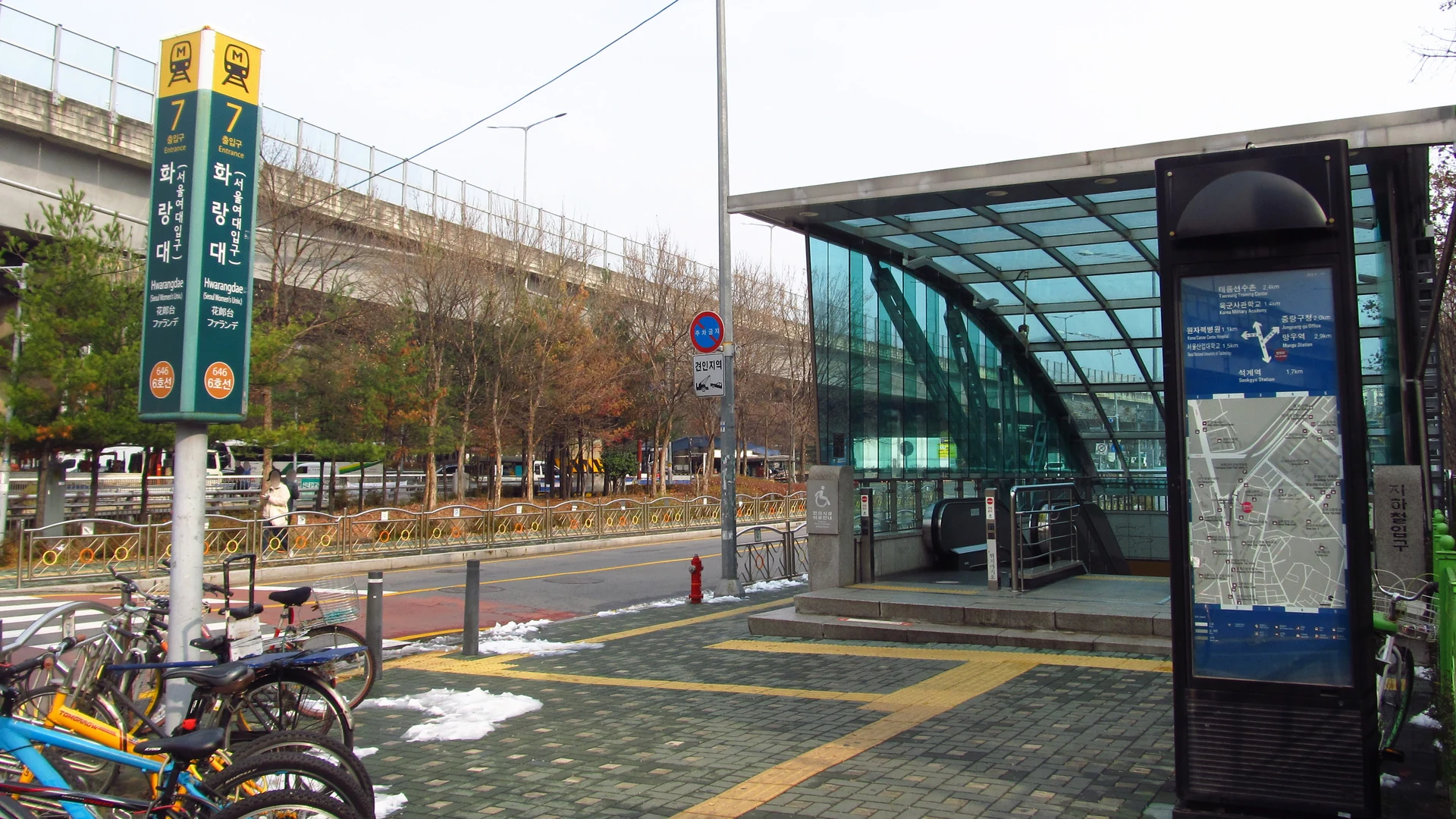
Hwarangdae Station Exit 7. Elevator access and entrance layouts vary by station. Hwarangdae Station Exit 7 — photo by LERK, cropped, licensed under CC BY-SA 4.0.
Some details may change. We mark unverified info clearly — please check the official website before visiting.
Byline: BabyMap Korea Editorial Team · Last updated July 16, 2026
Before leaving your hotel
- Check both the departure and arrival station. Do not check only the destination.
- Look for an elevator exit, not simply the nearest exit. The elevator may be on the opposite side of a large intersection.
- Save the exit number and line direction. A screenshot helps when mobile service is weak underground.
- Count transfers, not just minutes. One direct journey can be easier than a route that saves a few minutes but changes lines twice.
- Keep a backup plan. A carrier, a taxi for the final leg or a nearby alternative station can rescue a difficult route.
BabyMap planning note: station layouts and elevator operation can change. Treat route maps as a starting point, then follow signs and ask staff when the step-free path is unclear.
Why one subway trip may require several elevators
An elevator symbol beside a station name does not mean one elevator runs directly from the street to the platform.
The elevators can be at different ends of the station. This is why a transfer that looks short on a subway map may feel long with a stroller.
Typical step-free journey
- Street
- Elevator A
- Concourse and ticket gates
- Elevator B
- Platform
Extra elevators at a transfer
- First platform
- Elevator C
- Transfer passage
- Elevator D
- Second platform
Seoul’s official accessibility table lists elevators and other mobility facilities station by station. It is useful for confirming that facilities exist, but it does not replace an exact route through every entrance and corridor.
How to find the right elevator entrance
Look for the elevator pictogram and wheelchair-accessibility symbol on exit maps, street signs and station directories.
A practical order is:
- Check the station map before entering.
- Follow the elevator symbol rather than the closest stair icon.
- Confirm that the elevator reaches the ticket-gate level.
- After tapping through the gate, look again for the platform elevator.
- At your destination, confirm the exit number before going up.
If the elevator route is unclear, show the stroller to a station employee and ask. Staff can often point out a different passage or exit more quickly than repeated trial and error.
Do not assume every exit is step-free. A station may have elevators while several other exits remain stairs-only.
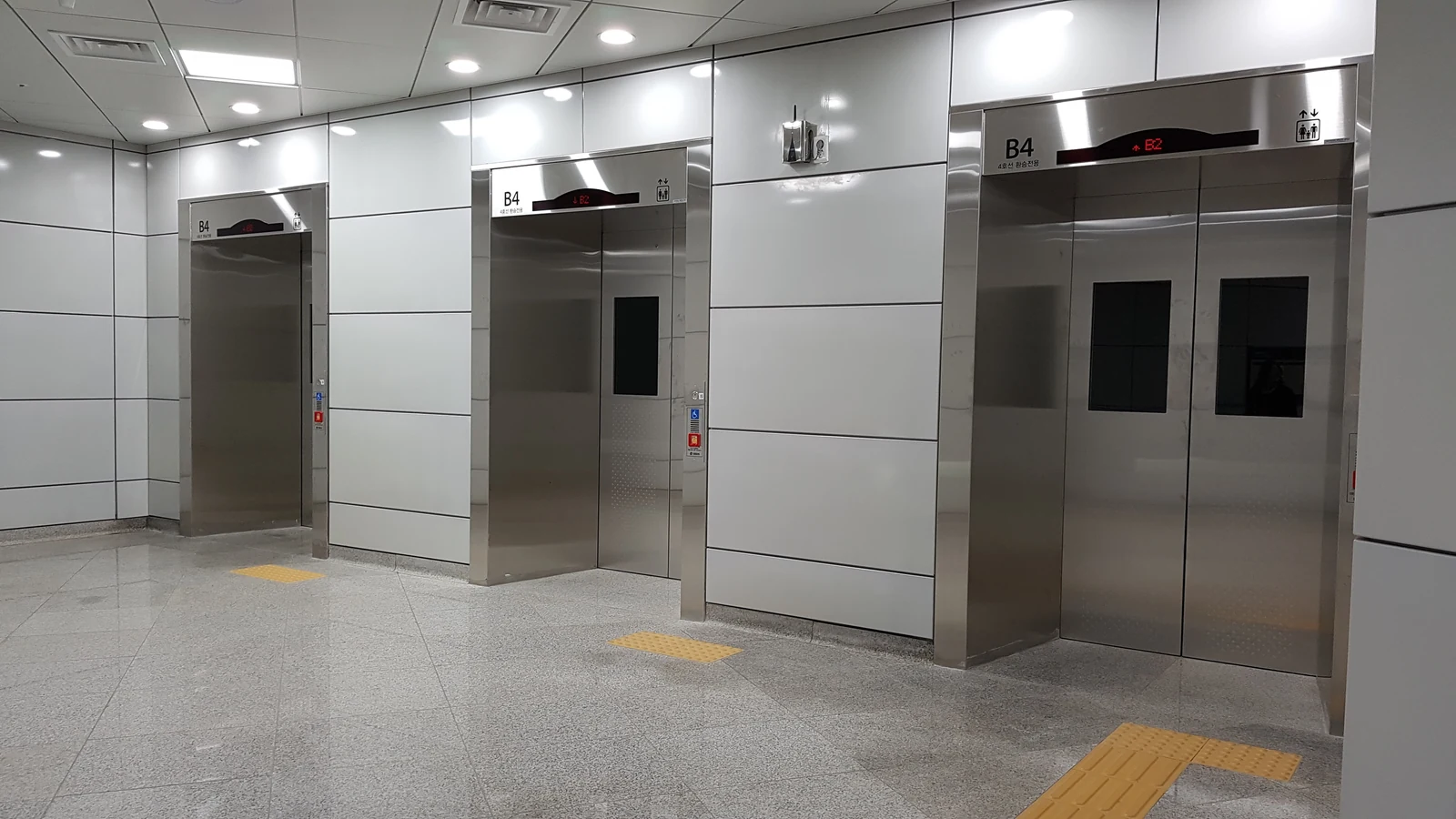
Passing through the ticket gates
A stroller may not fit comfortably through a standard narrow gate. Look for a wider accessible gate, often positioned at the end of the gate line or near a staffed area.
Simplified illustration — layouts vary by station
Standard gate
Often too narrow for a stroller. Do not force the wheels through.
Wider accessible gate
Usually at the end of the gate line or near a staffed booth.
Ask staff
If the wide gate is closed or hard to find, ask for help.
- Tap your transport card as directed.
- Let the stroller clear the gate before rushing forward.
- If the wide gate is closed or difficult to identify, ask station staff.
- Do not force a stroller through a narrow gate.
Boarding and riding safely
Let passengers leave before moving the stroller toward the door. Inside the carriage:
- keep at least one hand on the stroller;
- use the brake when the train is moving;
- keep bags from hanging where they can pull the stroller backward;
- avoid blocking the doorway; and
- move farther inside when space allows.
Space varies by train and time of day, so do not build your plan around finding a particular open area inside the carriage.
There is no universal BabyMap-verified rule that every stroller must be folded on every Seoul subway ride. In a crowded carriage, however, a compact folded stroller or baby carrier may be much easier and more considerate.
Transfers: choose the simpler route
For stroller travel, the “fastest” route is not always the best route.
A route with one transfer may be easier than a two-transfer route even when the app shows a slightly longer arrival time. Large interchange stations can involve long corridors, several levels and elevators located away from the quickest stair route.
Before choosing a transfer:
- compare the number of line changes;
- check whether the transfer station is large;
- avoid very tight connections;
- confirm the correct platform direction before taking an elevator down; and
- allow time to backtrack if a lift serves only one side.
If your child is tired or the station is extremely crowded, getting off one station earlier or later and using a taxi for the final leg can be a reasonable family decision.
Crowded times and busy places
Weekday morning and evening commuting periods can make boarding, transferring and finding elevator space harder. When your schedule allows, travel outside those periods.
Crowding is also affected by:
- major interchange stations;
- stadium or event traffic;
- popular shopping districts;
- weekend attractions; and
- weather that pushes more people underground.
A stroller is not automatically unsuitable in Myeongdong, Jamsil, Hongdae or Seongsu, but busy entrances and crowded pavements may make the final walk harder. Check the exact station exit and destination entrance rather than judging an entire neighbourhood from one label.
Stroller or baby carrier?
A stroller is often helpful for
- long museum or shopping-mall visits;
- parks and riverside paths;
- nap time during a full-day itinerary;
- carrying a small diaper bag; and
- routes with one direct train and an elevator-connected destination.
A carrier may be easier for
- traditional markets and narrow alleys;
- hillside neighbourhoods;
- routes with several transfers;
- a short outing during commuting hours; and
- days when one adult must also manage several suitcases.
Many families will use both: a compact stroller for most of the day and a carrier as the backup when the elevator route becomes inconvenient.
What to do if an elevator is out of service
Do not assume the only option is to carry an occupied stroller on stairs.
- Ask station staff for another elevator route.
- Check whether a different exit reaches the same side of the road.
- Backtrack to the concourse if the lift serves the wrong platform.
- Consider one nearby station or a taxi for the final section.
- If you decide to use stairs, remove the child first and only move the folded stroller when it is safe to do so.
Real-time conditions can differ from static station information. This is one reason the guide avoids promising a perfect step-free route at every station.
Korean phrases to show station staff
엘리베이터가 어디에 있어요?
Where is the elevator?
유모차로 갈 수 있는 출구가 어디예요?
Which exit can I use with a stroller?
넓은 개찰구가 어디에 있어요?
Where is the wide ticket gate?
이 엘리베이터가 승강장까지 가나요?
Does this elevator go to the platform?
2호선으로 환승하려면 어디로 가야 해요?
Where should I go to transfer to Line 2?
엘리베이터가 운행하지 않는데 다른 길이 있나요?
The elevator is not operating. Is there another way?
Useful official tools
Seoul Subway Accessibility Facilities
Seoul’s official station-by-station table lists elevators, escalators and other mobility facilities. Use it to confirm that a facility is listed at a station—not to assume that every exit is step-free or that a lift is operating in real time.
Open accessibility facilities tableSeoul Metro accessibility guidance
Seoul Metro has announced mobile guidance designed for passengers with reduced mobility, including caregivers travelling with infants. Features and coverage can change, so treat mobile guidance as a planning aid and keep station signs and staff help as a backup.
Open Seoul Metro accessibility noticeSeoul Danurim Accessible Tourism
Seoul Danurim is the city’s official accessible-tourism service for travellers with disabilities, older visitors and people travelling with infants. It can help when a subway question is part of a wider accessibility or itinerary problem.
Open Seoul DanurimFAQ
No. A station may have one or more elevators while many other exits remain stairs-only. Check the exit, not only the station name.
How this guide was checked
BabyMap Korea reviewed Seoul’s official station accessibility-facility table, Seoul Metro’s official accessibility-service announcements, Seoul Danurim’s accessible-tourism information, official subway visitor guidance, and recurring questions reported by parents travelling with strollers.
Static official information cannot guarantee that an elevator is operating at the exact moment of travel. This guide therefore separates confirmed facilities from route-planning advice.
Last checked: July 16, 2026
Sources
- Seoul Metropolitan Government — Subway Accessibility Facilities
- Seoul Metropolitan Government — Mobile App Services for Enhanced Subway Accessibility
- Seoul Danurim — Accessible Tourism Information
- Visit Seoul — Seoul Subway Guide
- Wikimedia Commons — Hwarangdae Station entrance photo, LERK, CC BY-SA 4.0
- Wikimedia Commons — Sungshin Women’s University Station transfer-elevator photo, Udonhan1992, CC0